Service Designer & User Researcher
Experiential Fragrance Discovery
Indigo Design Awards 2026 – Silver Winner in UX, Interface & Navigation for Digital Design
Role: Service Designer, Test Facilitator
Skills: Cardboard Prototyping, Conversational Prototyping, Desktop Walkthrough, Prototype Assumption and Question Development

Problem
Fragrance shoppers often face decision paralysis in stores—overwhelmed by options, uncertain of what suits them, and unsure how to describe their preferences.
What I Did
To ensure desirability, usability, and feasibility, I used iterative, multimedia prototyping to identify and test assumptions across the user journey—from first encounter to post-purchase engagement.
Outcome
We delivered a refined multi-channel prototype that simulated the entire experience of using the recommendation service in a retail environment, and identified KPIs for measuring its success in the real world.
Background
In a previous class, a teammate and I conducted primary research into the challenges with the current fragrance shopping experience.

Fragrance Shopper Pain Points
-
Feel overwhelmed by the amount of choices available
-
Lack the vocabulary or understanding of what they like and dislike
-
Prefer experiences that engage multiple sense
We set out to design a fragrance recommendation service that would address the key customer jobs-to-be-done, including:
-
Taste-Based Curation: Guide me toward a manageable selection that aligns with my tastes
-
Confident Exploration: Give me confidence that I'm exploring the most relevant options for my preferences
-
Efficient In-Store Experience: Make in-store shopping experience more efficient and less overwhelming
-
Build My Knowledge: Help me understand what I like and dislike in fragrance
To ensure desirability, usability, and feasibility, we used iterative service prototyping to identify and test assumptions across the user journey—from first encounter to post-purchase engagement.
Moment-of-Truth
& Solution
By documenting the current customer journey, we identified the moment-of-truth as the point when customers explored fragrance options but had to make a decision without fully understanding what suits them.
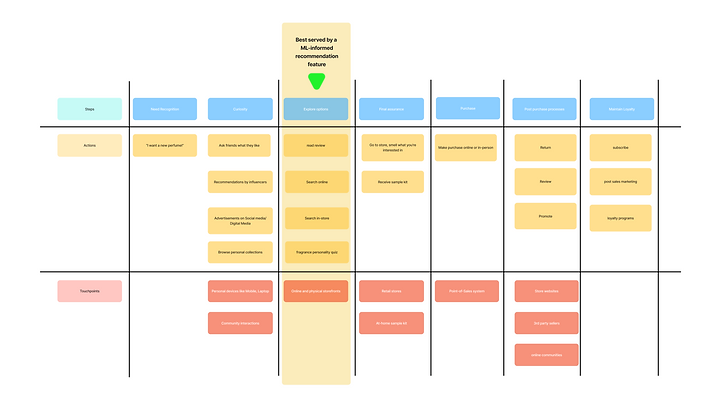
Our solution concept was an ML-supported fragrance recommendation system and sampling booth, that would intake shopper inputs, provide them three personalized recommendations, and give them a multi-sensory sampling experience.
We aimed to reimagine fragrance discovery with the integration of digital intelligence to create experiences that connected customers with scents they truly loved.
Project Phases
Over the course of 7 weeks, we ran three key phases of prototyping. Each phase addressed different assumptions and questions about our proposed service solution, and employed a variety of methods.
Phase 1:
Desirability of an In-Booth, Multisensory Recommendation Service
Prototype:
Cardboard Booth, Role Play, and Paper Wireframes
Phase 2:
Usability of booth questions, recommendation, and knowledge-building
Prototype:
Conversational prototype
Phase 3:
Usability, desirability, and feasibility of end-to-end customer journey
Prototype:
Service Advertisement, Desktop Walkthrough, Wireframes
Phase 1:
Desirability
Before we moved further with refining the concept, we needed to ensure that our proposed solution, the multi-sensory booth recommendation service, was desirable. For that reason, Phase 1 focused on testing if the basic concept of the experience actually addressed the fragrance shopper's jobs-to-be-done.
Assumptions Tested:
-
A fragrance recommendation service will help the customer clarify their preferences and make a choice
-
Immersive elements with the recommendations enhance user’s confidence and decision-making
Key Questions:
-
Does having a recommendation system help in the decision-making process for fragrance?
-
Do multi-sensory elements such as sound and images give the user more confidence in their selection?
Prototype: Cardboard Booth and Paper Wireframes

What We Learned:
-
The recommendation tool was welcomed and seen as helpful by users
-
Mood-based prompts spark imagination around use-cases and occasions
-
Multisensory immersion deepens connection and improves self-awareness of scent fit
Phase 2:
Usability
From Phase 1, we were confident in the desirability of the core value proposition. However, we saw friction points with the short quiz--completed through the paper wireframes--before receiving recommendations. Testers had other inputs they wanted to provide about their preferences, and struggled with certain questions based on if they were a novice to fragrance or had some knowledge.
We created a conversational prototype, with different paths based on the user's experience level, to test if the flow of providing their inputs to the recommendation service was usable.
Assumptions Tested:
-
Can a flexible conversation flow support users with varying fragrance knowledge?
-
Do users feel like their answers shape the outcome meaningfully?
Key Questions:
-
Does the tone build trust?
-
Where do users hesitate or go off-script?
-
Does the conversation guide or confuse?

What We Learned:
-
Users appreciated being asked about their scent experience level
-
Mood-based questions felt personal and sparked imagination.
-
Moments of switching to saving the recommendations to their wishlist were clunky and difficult
We updated the conversational flow based on the findings and built that into our Phase 3 prototype.
Phase 3:
Desirability,
Usability, &
Feasibility
In Phase 3, we set out to test the desirability, usability, and feasibility of the most important touchpoints of the service working in tandem. We mapped out the overall user journey on a service blueprint to identify the key moments that we still had assumptions around that we needed to include in our prototpe.
Assumptions Tested:
-
Does the idea of a scent personality intrigue users and help build their knowledge?
-
Can the full service journey—from window display to checkout—feel seamless and effectively serve user needs?
Key Questions:
-
How do users respond to the introduction of the sales associate as the sample delivery channel?
-
Do users feel they have a better understanding of their scent preferences after receiving the summary?
-
Are users and sales associates able to interact and understand their roles seamlessly?
-
Can the system consistently support real-time coordination between booth inputs and sales associate actions?
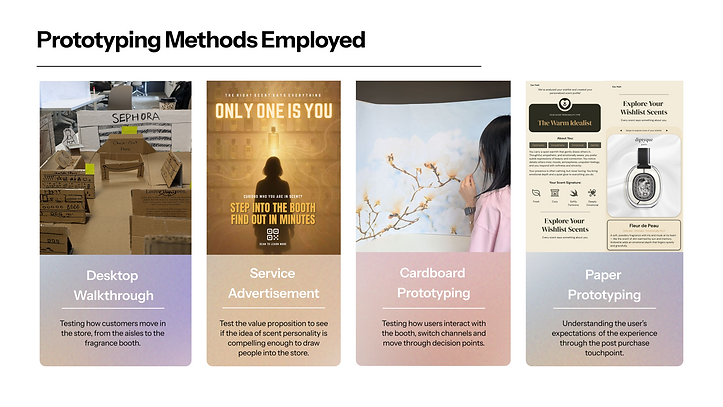
We tested the full experience with the desktop walkthrough, and used the other prototypes to answer key questions about specific touchpoints.
What We Learned:
-
Booth placement affects feasibility and viability of the service
-
Scent delivery channels are critical to user comfort and overall experience
-
Post-experience personalization is essential for continued engagement and retention
Final Service Concept
After multiple rounds of prototyping and testing, our final concept was a scent discovery booth placed outside of the store to attract business, blending:
-
Personalized recommendations driven by mood, preference, and personality
-
A multisensory booth with guided conversation, visuals, and curated samples, that would deliver samples through a technical solution
-
System-enabled follow-up, including wishlist saving and email scent personality summaries


Evaluating Viability
While we had successfully validated the concept, we still needed to consider the viability of introducing a service such as this at retail Sephoras.
Technical Viability: Can Machine Learning support a fragrance recommendation system?
We built a statistically significant predictive model using Orange 3 and a training dataset from Fragrantica (via Kaggle). Sephora could feed its proprietary product data into this system, enabling dynamic recommendations based on user inputs around mood, preferences, and scent profiles.
Business Viability: Is the recommendation booth worth it?
We estimated that removing one fragrance shelf to install the booth would reduce product visibility by 2.94%, resulting in a projected 0.29% drop in store revenue. However, our prototype testing showed a 90% desirability rate, suggesting strong customer interest. We believe the improved decision-making and customer engagement enabled by the booth could drive at least a 1% increase in conversion—more than offsetting the potential revenue loss from fewer visible products.
KPI Definition
We identified KPIs to measure the success of the service in achieving its goals including:
-
Goal: Fragrance shoppers feel supported, satisfied, and helped by the booth recommendation system
-
Completion rate of booth experience
-
No. of people who interact with the recommendations provided by the system via wishlist
-
Ratio of users that leave their email to receive scent personality to those that don’t
-
Repeat engagement, measured by number of email hyperlink interactions
-
-
Goal: Increase revenue for retailer
-
Retail fragrance revenue before and after booth introduction
-
Outcome
Throughout our process, we:
-
Validated 10+ key assumptions using 5 prototyping methods
-
Built a clear path from casual browsing to confident scent selection
-
Developed business rationale and success metrics for introduction of the booth
Reflections
Service prototyping requires creativity. The multi-channel nature of services means you cannot easily fallback on always wireframing screens. When you work with lower-fidelity, you often get clearer validation or rejection of your assumptions, because your testers are not distracted by beautiful UI. Conversational prototyping is a particularly powerful, low-fidelity technique for these reasons.
Prototyping services functions not only as a tool to test your service, but as a method of alignment amongst team members. When we begin creating out prototypes, we found we all had very different ideas of how it would function, and clarifying mechanisms by building prototypes together ensured we worked through fine details.